
Frustration with Salesforce consulting is not about skill.
It’s often about pricing mechanics.
If you’ve hired consultants before, you’ve probably experienced some version of the same pattern.
An hourly rate is proposed.
A rough estimate is given.
Someone warns about “scope changes.”
Then invoices begin drifting upward as the work gets more complicated.
At some point the question shows up — quietly at first, then more directly.
Usually in the CFO’s voice.
“Why can’t someone just give me a clear number?”
This article explains how Salesforce consulting pricing typically works, what each pricing model incentivizes, and how Cloud Trailz structures pricing so Salesforce support behaves more like a predictable operating expense than a suspense novel.
Why Companies Struggle With Salesforce Consulting Pricing
Nobody shops for Salesforce hours.
What companies actually want is stability.
When leaders invest in Salesforce, they want the system to behave like infrastructure, something reliable and predictable.
That usually means three things.
They want:
• Salesforce that works the same way on Monday as it did on Friday
• A partner who remembers the system and the business rules
• Costs that can be forecasted and approved without surprises
Those expectations sound simple.
But traditional Salesforce consulting pricing models often create the opposite outcome.
Instead of predictability, companies end up managing invoices, scope discussions, and change requests.
The result is a CRM system that never quite feels stable.
The Pattern Most Teams Have Experienced
Most organizations that have hired Salesforce consultants have lived through some version of the same cycle.
A sales leader asks for a workflow improvement.
Operations wants cleaner data.
Finance wants reporting that matches the real pipeline.
Everyone agrees Salesforce should be able to do these things.
But what starts as a “small change” quickly expands.
The project requires multiple meetings.
Requirements evolve as stakeholders see the system.
Automation behaves differently than expected.
Permissions become complicated.
By the time the work finishes, the original estimate has expanded and the team managing Salesforce has changed.
Sometimes the consultant rotates off the account just as they finally understand how your company actually sells.
This cycle is one of the most common frustrations with Salesforce consulting pricing.
And it often leads to something worse than budget overruns.
It leads to low CRM adoption.
When teams lose trust in the system, they begin working around it instead of through it.
Why Hourly Billing Exists in Salesforce Consulting
To be clear, hourly billing is not unethical.
In fact, hourly billing exists for a good reason.
Salesforce environments are complex systems.
Requirements change.
Integrations behave unpredictably.
Stakeholders often refine what they need after seeing the system in action.
Because of this uncertainty, hourly Salesforce consulting pricing protects consulting firms when projects evolve.
If work expands beyond the original estimate, the firm can still cover the additional time required.
For many organizations, especially those running one-time implementation projects, this structure can work well.
But the same pricing structure can feel volatile from the client side.
Why Hourly Salesforce Consulting Pricing Feels Volatile
From the client perspective, hourly consulting creates a different experience.
Variability shows up in several ways.
Invoices change from month to month.
Costs increase when requirements evolve.
Decision-making slows down because teams worry about triggering more billable hours.
Over time, companies begin managing the consulting meter instead of managing the system itself.
Instead of asking “what does Salesforce need to work better?” the conversation becomes “how much will this cost?”
That shift in focus can quietly undermine CRM progress.
The Most Common Salesforce Consulting Pricing Models
If you’re comparing Salesforce partners, you’ll usually see one of several pricing structures.
Understanding these models helps clarify how Salesforce consulting pricing influences behavior.
Hourly Billing
Hourly billing is one of the most common pricing models.
Typical hourly rates range from $150 to $300+ per hour, depending on experience and specialization.
This structure works best when:
• requirements are tightly defined
• approvals happen quickly
• the organization only needs short bursts of execution
However, if requirements evolve frequently, hourly billing can lead to unpredictable spend.
Project-Based Pricing
Another common structure is a fixed quote for a defined project.
This approach can work well when requirements are stable.
However, many Salesforce environments evolve during the project itself.
As stakeholders interact with the system, new needs emerge.
When those changes happen, additional work is usually handled through change orders, which expand the project scope and cost.
Time and Materials (T&M)
Time and materials engagements are similar to hourly billing but may include a weekly or monthly cap.
Clients often purchase a block of consulting hours in advance.
This structure can reduce some volatility, but the core incentive remains the same: revenue is tied to time spent.
Usage-Based Retainers
Some consulting firms price services based on ticket volume or consumption metrics.
While this can appear predictable, it often hides complexity.
One “ticket” could be a simple password reset.
Another ticket might require redesigning automation across multiple objects.
Because of that variability, ticket-based Salesforce consulting pricing can still create surprises.
Why Cloud Trailz Doesn’t Bill Hourly
At Cloud Trailz, we made a deliberate decision not to structure our pricing around hourly billing.
The reason is simple.
Pricing models create incentives.
And incentives shape behavior.
Under most time-based consulting agreements, the following activities increase cost:
• clarifying requirements after stakeholder meetings
• internal indecision that delays approvals
• discovery work needed to design the best solution
• revisions required after adoption challenges appear
The meter has to run for the model to work.
We wanted our incentives to align differently.
The Cloud Trailz Model: Fixed-Price Managed Services
Instead of billing hourly, Cloud Trailz operates using a fixed-price managed services model.
This means Salesforce support functions more like a subscription.
Clients receive ongoing Salesforce management for a consistent monthly investment.
This structure includes:
• one flat monthly investment
• no hourly billing meter
• predictable invoices
• defined scope boundaries
• continuous optimization
The goal is simple.
Salesforce should behave like a stable operational system, not a series of disconnected consulting projects.
Why Incentives Matter in Salesforce Consulting Pricing
When evaluating Salesforce consulting pricing, it helps to understand what each model rewards.
Hourly Billing Incentives
Hourly consulting tends to reward:
• time spent
• task completion
• revisions and iterations
• expanding scope
None of these incentives are inherently wrong.
But they prioritize activity rather than efficiency.
Fixed-Price Incentives
Fixed pricing shifts the incentives.
It tends to reward:
• efficiency
• process clarity
• proactive problem solving
• long-term client relationships
Because wasted cycles increase our cost, we focus heavily on preventing problems instead of reacting to them.
Why We Treat Salesforce Like Infrastructure
Salesforce is rarely “done.”
New hires join the company.
Sales processes evolve.
Leadership asks for new reporting.
Integrations change.
If Salesforce support is treated like a series of disconnected projects, the organization repeatedly pays the “start-up cost” of rebuilding context.
That context disappears every time a new consultant joins the engagement.
Cloud Trailz was built around continuity.
The same team learns your system.
The same playbook guides improvements.
And the same accountability remains month after month.
How Cloud Trailz Pricing Works
Our pricing structure is intentionally simple.
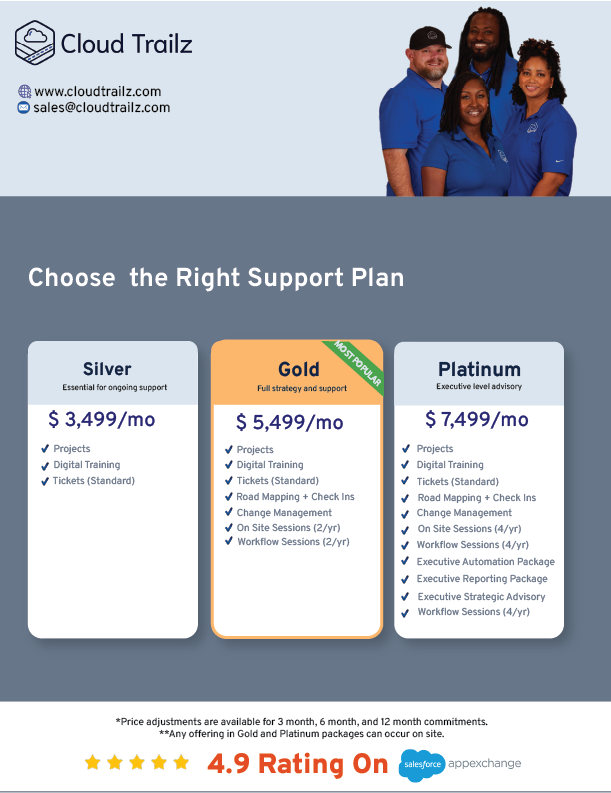
Most Cloud Trailz clients fall within a monthly investment range between $3,500 and $7,500, depending on the complexity of their Salesforce environment.
Several factors influence where a company falls within that range.
These include:
• number of Salesforce users
• automation and object complexity
• integration requirements
• level of strategic involvement required
The number is known before work begins, and it stays consistent.
Predictability is the entire point of the model.
When Fixed-Price Salesforce Consulting Isn’t the Right Fit
While our model works well for many companies, it is not the right structure for everyone.
Some scenarios are better served by hourly or project-based consulting.
For example:
• one-time configuration projects
• very small budgets under $5,000
• organizations seeking purely transactional support
• companies that only need help when something breaks
Those situations often align better with traditional consulting firms.
Our model is designed for companies that want long-term stability and continuous improvement.
The Real Risk Is Volatility
When comparing Salesforce consulting pricing models, many companies focus on hourly rates.
But the larger risk often comes from volatility.
Volatile scope slows decision-making.
Volatile invoices tighten budgets.
Volatile support reduces CRM adoption.
Once that cycle begins, Salesforce can quickly become a bottleneck rather than a system that helps the business grow.
Stability compounds.
So does chaos.
How to Evaluate Any Salesforce Consulting Pricing Model
If you’re evaluating Salesforce partners, a few simple questions reveal how their pricing structure actually works.
Consider asking:
• What causes the price to change?
• How do you prevent rework?
• What happens when requirements evolve?
• Who stays assigned to our account?
• How do you maintain context over time?
• How do you define a successful outcome?
A well-structured consulting model should answer these questions clearly.
Want a Clear Number for Salesforce Support?
If you’re trying to understand what Salesforce support should realistically cost for your organization, we’re happy to walk you through it.
At Cloud Trailz, we’ll review your Salesforce environment, explain how our pricing tiers work, and give you a clear monthly number.
No surprises. No billing meter.
Just a straightforward conversation about what it would take to keep Salesforce running the way your business needs it to.
If that sounds helpful, reach out to Cloud Trailz and we can take a look together.